






Undergraduate
- Courses
- Structure
- Requirements
Courses
|
Classification |
Course No. |
Computer Code |
Course Name |
Lecture; Lab.; Credit (Assignment) |
Semester |
Note |
|
Basic Course |
MS211 |
34.211 |
Introduction to Materials Science and Engineering |
3:0:3(3) |
Spring, Fall |
|
|
Mandatory Major courses |
MS212 |
34.212 |
Thermodynamics of Materials |
3:0:3(3) |
Spring |
|
|
MS213 |
34.213 |
Crystallography and Diffraction |
2:3:3(3) |
Fall |
|
|
|
MS310 |
34.310 |
Quantum Chemistry for Materials Scientists |
3:0:3(3) |
Spring |
|
|
|
MS311 |
34.311 |
Phase Transformation and Microstructure Evolution |
3:0:3(3) |
Fall |
|
|
|
MS321 |
34.321 |
Advanced Materials LabⅠ |
1:6:3(6) |
Spring |
|
|
|
MS322 |
34.322 |
Advanced Materials Lab Ⅱ |
1:6:3(6) |
Fall |
|
|
|
Elective Major courses |
MS214 |
34.214 |
Application of Thermodynamics to Materials Science and Engineering |
3:0:3(3) |
Fall |
|
|
MS215 |
34.215 |
Mechanical Behavior of Materials |
3:0:3(3) |
Fall |
|
|
|
MS216 |
34.216 |
Electrical and Magnetic Properties of Materials |
3:0:3(3) |
Spring |
|
|
|
MS217 |
34.217 |
Organic material chemistry |
3:0:3 |
Spring |
|
|
|
MS331 |
34.331 |
Nanomaterials Science & Technology |
3:0:3(3) |
Spring |
|
|
|
MS333 |
34,333 |
Inorganic Materials Chemistry |
3:0:3 |
Fall |
|
|
|
MS340 |
34.340 |
Polymer Materials |
3:0:3(3) |
Fall |
|
|
|
MS354 |
34.354 |
Electrochemistry for Materials Science |
3:0:3(3) |
Fall |
|
|
|
MS360 |
34.360 |
Mechanics of Materials |
3:0:3(3) |
Fall |
|
|
|
MS371 |
34.371 |
Structure and Properties of Engineering Alloys |
3:0:3(3) |
Spring |
|
|
|
MS381 |
34.381 |
Introduction to Solid State Physics |
3:0:3(3) |
Fall |
|
|
|
MS412 |
34.412 |
Material Design and Manufacturing Process |
2:3:3(5) |
Spring |
◎ |
|
|
MS414 |
34.414 |
Materials Characterization |
3:0:3(3) |
Fall |
◎ |
|
|
MS415 |
34.415 |
Introduction to Semiconductor Devices |
3:0:3(2) |
Spring |
◎ |
|
|
MS421 |
34.421 |
Introduction to Ceramics |
3:0:3(3) |
Spring |
◎ |
|
|
MS424 |
34.424 |
Circuits and Electronics for Materials Engineering |
3:0:3(3) |
Fall |
◎ |
|
|
MS425 |
34.425 |
Introduction to Biomaterials |
3:0:3(3) |
Spring |
◎ |
|
|
MS431 |
34.431 |
Nano-Biomaterials |
3:0:3(3) |
Fall |
◎ |
|
|
MS435 |
34.435 |
Applied Mathematics for Materials Science and Engineering |
3:0:3 |
Fall |
◎ |
|
|
MS436 |
34.436 |
Electrodynamics and Its Applications for MSE |
3:0:3 |
Spring |
◎ |
|
|
MS441 |
34.441 |
Introduction to Display Materials |
3:0:3(3) |
Fall |
◎ |
|
|
MS442 |
34.442 |
Sensor Materials and Applications |
3:0:3 |
Fall |
◎ |
|
|
MS461 |
34.461 |
Advanced Materials Quantum Mechanics and Artificial Intelligence |
3:0:3 |
Spring |
◎ |
|
|
MS462 |
34.462 |
Advanced Materials Quantum Mechanics Application |
3:0:3 |
Spring or Fall |
◎ |
|
|
MS481 |
34.481 |
Semiconductor Processing |
3:0:3(2) |
Fall |
◎ |
|
|
MS482 |
34.482 |
Special Topics in Materials Science and Engineering |
3:0:3(3) |
Spring, Fall |
◎ |
|
|
Research |
MS490 |
34.490 |
Research in Materials Science and Engineering |
0:6:3(3) |
|
|
|
MS495 |
34.495 |
Individual Study |
0:6:1(3) |
|
|
|
|
MS496 |
34.496 |
Seminar |
1:0:1(3) |
|
|
◎: Course mutually recognized by undergraduate and graduate programs
※ Course classification, course title, and mutual recognition of credits may differ according to the effective year of the requirements.
Descriptions of Courses
- MS211 Introduction to Materials Science and Engineering
This course covers atomic bonding, crystal structures, crystal defects, diffusion, phase diagrams and microstructures, mechanical and electromagnetic properties of metals, ceramics, semiconductors and polymers.
- MS212 Thermodynamics of Materials
This course introduces the essential features of zeroth, first, second, and third laws of thermodynamics and their application to materials, statistical interpretation of entropy, and experimental techniques used to measure thermodynamic functions. Furthermore, this course deals with surface phenomena and considers their application not only to hydrostatic system, but also to magnetic, dielectric, piezoelectric and mechanical systems.
- MS213 Crystallography and Diffraction
This course deals with chemical bonds, atomic packing as a consequence of bond type, crystal structures by atomic packing, lattice and symmetry in crystals, reciprocal lattice and Ewald sphere. Principles and applications of optical, X-ray, and electron diffraction to crystal structure characterization, laboratory for basic techniques of optical, X-ray, and electron diffraction are covered.
- MS214 Application of Thermodynamics to Materials Science and Engineering
This subject aims to establish an in-depth understanding of the chemical phenomena occurring at the materials exposed to the high temperature, which provides a capability to design a new materials and an optimum high temperature material-process. Especially, the knowledge obtained in this course can help to predict the equilibrium phase and composition of materials at a given state.
- MS215 Mechanical Behavior of Materials
This course introduces to sophomores the concept of dislocations and to understand the role of dislocations on mechanical properties of materials. Topics include: application of principles of linear elastic fracture mechanics to brittle fracture and to fatigue crack propagation and reviews elasticity theory, elements of plasticity, and strengthening mechanisms.
- MS216 Electrical and Magnetic Properties of Materials
This course will offer the opportunities to understand the electrical and magnetic properties of various materials such as metals, semiconductors, and insulators, This purpose of this course is to understand electron’s behavior in solid, band structures of materials, general properties of semiconductors and their devices, and orcin of magnetic properties.
- MS217 Organic material chemistry
The goal of this class is as follows.
(1) Learning basic organic chemistry for materials science and engineering.
(2) Exploring the organic materials and their functions.
- MS310 Quantum Chemistry for Materials Scientists
Understanding quantum chemistry is a necessity for materials scientists. This course covers wave-particle duality, the Schroedinger equation, the hydrogen model, molecular orbitals, symmetry of molecules, spectroscopy, and basic principle of characerization of solid materials.
- MS311 Phase Transformation and Microstructure Evolution
The objective of this course is to provide juniors in MS&E with the concepts and models which are required to understand the formation and evolution of microstructures in both the crystalline solids and thin films. The topics include: thermodynamics of solid solutions, phase equlibria, diffusion equations and solution, interdiffusion, surface diffusion, surface energies and thin film formation, interface structures and energies, interface energies and equilibrium shapes, grain growth and recrystallization, solidification and crystal growth; homogeneous and inhomogeneous nucleation in solids, growth and overall transformations kinetics, spinodal decomposition and coarsening, massive transformations, ordering transformations, martensitic transformations, transformation kinetics in thin films, surface kinetics processes, grain formation and evolution, thin film stresses, epitaxial growth, solid phase amorphization and crystallization, and thin film reactions.
- MS321 Advanced Materials Lab I
This course is organized to give the basic theories and concepts through the introductory experiments about the phase diagrams and material characteristics. Tensile test for mechanical properties, electrical transport phenomena for electrical properties are included. Safety, technical writing, experimental design and error analysis are also introduced.
- MS322 Advanced Materials Lab II
This course introduces how to tailor the properties and performance of materials by modifications in compositions and microstructures through synthesis and processing. Also, general microfabrication technologies, in which photo-lithography, diffusion of dopant, Si oxidation, and thin film deposition are included, are introduced on the basis of term projects.
- MS331 Nanomaterials Science & Technology
This course covers the techniques for patterning materials at the nanometer length scale. Topics include: nanostructure, self-assembly, nanoimprint lithography, scanning probe lithography, organic semiconductors, nanopatterning, atomic layer deposition, nanoelectronics, colloidal crystals, mesostructures, circuits and programmable assembling DNA.
- MS333 Inorganic Materials Chemistry
This class enables students to learn electrical properties and other physical and chemical properties through understanding of chemical bonds that determine the properties of various materials, and expand them to various material applications based on this.
- MS340 Polymer Materials
The course is to collect and organize understanding of the relationships between structure, properties and applications of polymer materials. The major polymer properties such as processability, mechanical, thermal, electrical, optical, acoustic, chemical and surface properties will be discussed from various aspects of polymer structures.
- MS354 Electrochemistry for Materials Science
This course is designed to provide undergraduate students in materials science and engineering with fundamentals of electrochemistry and electrode kinetics pertinent to metallic corrosion and energy devices such as lithium batteries, fuel cells, and electrolyzers.
Prerequisites : MS214 and MS215
- MS360 Mechanics of Materials
Basic topics of mechanics of materials are covered including: concept of stress and strain, axial loading, torsion, bending and shear. Stress and strain transformation, bending of beam and shaft, combined loading will be included. Some of current development in mechanics of materials are also discussed.
- MS371 Structure and Properties of Engineering Alloys
This course presents the relationship between phase transformations, microstructures and the mechanical properties of metals and alloys. Applications to alloy design, processing, and heat-treatment are included. A consideration is made of mostly mechanical properties, structural stability, grain size, interstitial and subsitutional solutes, precipitates and second-phase particles.
- MS381 Introduction to Solid State Physics
This course teaches all the physical phenomena in solids from the point of wave concepts. It covers the lattice vibrations, electromagnetic waves, and electron waves. The importance interaction between those waves are emphasized. The wave theories are applied to explain the solid-state phenomena such as specific heat, thermal conduction, electron transport and scattering, light scattering, light transmission and reflection, and ionic polarization.
- MS412 Material Design and Manufacturing Process
This subject is intended to provide senior engineering students, who are interested in the materials science and engineering, with a general and practical understanding of the materials design and manufacturing process. This course deals with the topics of decision making, optimization, availability, planning, statistical approach, reliability and quality control. To understand these topics, the students are asked to practice design and manufacturing a specific system. Also, since computers are becoming very important in the design field, the role of computers in materials design will be introduced.
- MS414 Materials Characterization
In this course, we will cover some of commonly used characterization techniques in materials science—what are the basic operational principles of them, what types of information can they provide, how are they practically instrumented, and how are they applied to real-world materials research.
- MS415 Introduction to Semiconductor Devices
Concerning present and projected needs, this course provides a strong intuitive and analytical foundation for dealing with solid state devices. Emphasis is placed on developing a fundamental understanding of the internal working of the most basic solid state device structures, such as silicon based, metal-semiconductor contact, PN junction, MOS capacitor, bipolar transistor, and MOSFET.
- MS421 Introduction to Ceramics
This course covers broad area of physical properties of ceramics. Topics include: crystals and crystal structure of solids, defects, interfaces, material transport, phase equilibria, sintering, thermal, mechanical, optical, and electrical properties of ceramics.
- MS424 Circuits and Electronics for Materials Science and Engineering
This course aims to cultivate understanding of basic properties of electric circuit elements and their interconnections, which form the basis for designing and analyzing complex electronic systems. Fundamental concepts and laws are emphasized so that students can apply them to real devices in materials science and engineering research.
- MS425 Introduction to Biomaterials
The objective of this course is to provide basic concepts in biochemistry, structures and properties of key biological polymers, and interactions between biomolecules with environments. This course will also introduce properties and characterization methods for various biomaterials.
- MS431 Nano-Biomaterials
This class introduces the systematic study of the interactions between biomolecules and synthetic materials. Topics include non-covalent biomolecular interactions, biodegradable polymers, hydrogels, biological interfaces, tissue engineering, and gene therapy.
- MS435 Applied Mathematics for Materials Science and Engineering
This course is designed to help students equip applied mathematics for understanding core concepts of materals science and engineering. The main textbook is Basic Training in Mathematics written by Prof. Shankar at Yale University. Research papers in the field of materials science and engineering will be used as well. Group activities will be encouraged to discuss and learn the related math and its application to specific materials science and engineering topics such as structure-property relationship and thermodynamics/kinetics.
- MS436 Electrodynamics and Its Applications for MSE
The goal of this course is to teach electromagnetism (Maxwell equations and their meaning) and its application to specific research topics related to energy storage and harvesting. Additionally, students will learn to visualize Maxwell equations in order to apply the derived mathematics to other fields, such as heat/mass diffusion and meso-scale electromechanical properties, and to create patents that could lead to potential innovations in energy storage and harvesting.
- MS441 Introduction to Display Materials
The course is to study types and basics of the displays, the used components, materials and fabrication processes in the displays. The thin film transistor (TFT) which is a display operating device, the currently commercialized LCD and OLED, the future flexible displays and so on will be covered.
- MS442 Sensor Materials and Applications
The significance of sensor technology in substituting human senses is increasingly recognized. This lecture comprehensively introduces the fundamental operational principles of electronic nose sensors, aiming to replace olfactory functions, and explores practical applications including gas sensors, electrochemical sensors, infrared sensors, bio-sensors, and wearable senosrs. Additionally, it delves into the integration of sensor technology with machine learning techniques to advance ultra-precision diagnostic capabilities.
- MS461 Advanced Materials Quantum Mechanics and Artificial Intelligence
This lecture is to introduce the core methods of advanced materials quantum mechanics and their utilization to accurately Gibbs Energies. Also, the lecture will discuss the theories for artificial intelligence.
- MS462 Advanced Materials Quantum Mechanics Application
This lecture is to introduce the key application of advanced quantum mechanical calculation methods and their utilization to accurately calculate electronic/atomic state energies as well as thermodynamic/kinetic energies for key reactions such as CVD, ALD, and energy storage and conversion on advanced materials.
- MS481 Semiconductor Processing
Basic VLSI processing technologies such as crystal growth, doping, ion implantation, thin film deposition, lithography, etching, and interconnection and also electronic packaging technologies will be studied.
- MS482 Special Topics in Materials Science and Engineering
This course is primarily designed to cover contemporary and advanced topics in materials science and engineering and introduces undergraduates to related novel theories and applications.
- MS490 Research in Materials Science and Engineering
This course is an individual research in consultation with the thesis advisor for the B.S. thesis.
- MS495 Individual Study
This course is an extended participation in work of a research group. This course includes independent study of literature and direct involvement in group's research.
- MS496 Seminar
This course is composed of weekly seminars for undergraduate students interested in materials science and engineering. Students present seminars on current topics in materials research with discussion and critic from seminar participants.
Curriculum Structure
- 2nd Year
- 3rd Year
- 4th Year
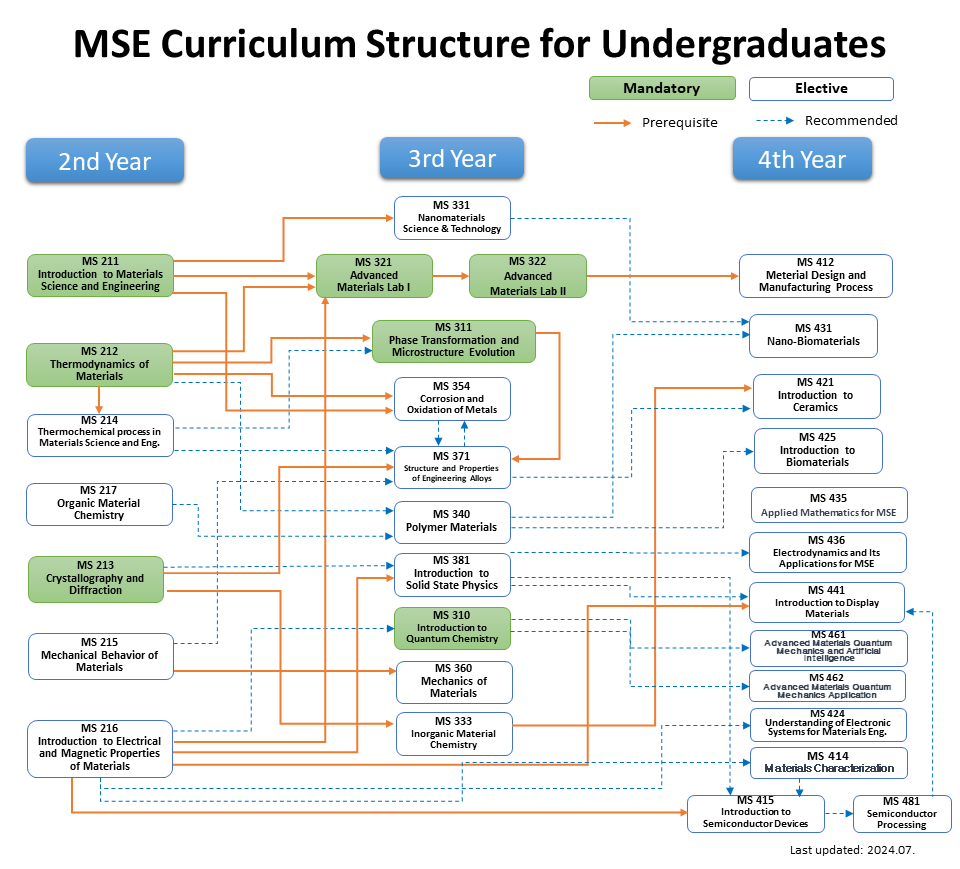
Course Requirements
|
Major Course Requirements for Dept. of Materials Science and Engineering (For undergraduate students admitted in 2024 and after) |
|
|
▣ Credit Requirement for Graduation: Required to complete a total of more than 138 credits ※ Required to choose and complete one among Advanced Major, Double Major, Minor, Individually Designed Major, Designated interdisciplinary major and Special Designated major. ▣ Major: at least 42 credits - Mandatory Major Courses: at least 18 credits MS212 Thermodynamics of Materials, MS213 Crystallography and Diffraction, MS310 Quantum Chemistry for Materials Scientists, MS311 Phase Transformation and Microstructure Evolution, MS321 Advanced Materials LabⅠ, MS322 Advanced Materials Lab Ⅱ - Elective Major Courses: at least 24 credits Up to two Elective Major courses(CoE code) opened by the College of Engineering are recognized as Elective Major Courses.
▣ Advanced Major: at least 12 credits - from Elective major course ▣ Individually Designed Major: at least 12 credits - Students must take 12 credits or more of major courses from more than two departments other than Materials Science and Engineering. ▣ Minor: at least 18 credits - at least 9 credits each from mandatory and elective major course. ※ No credits from the same course will be doubly counted to satisfy major and minor department requirements. ▣ Double Major: at least 42 credits - at least 42 credits from major courses, including 18 credits in required major courses. ※ Up-to 6 credits can be doubly counted to satisfy both major department requirements. ▣ Research Courses: at least 3 credits - Students must take 3 credits for Research in Materials Science and Engineering (MS490). - Credits from seminar and Individual Study are counted as Research Course credits. ※ Students having a double major are exempt. |
|
|
□ Transitional measures - Students who entered in 2024 or later should fulfill the current degree requirements. - Students who entered before 2023 should refer to the degree requirements in the respective year. - Requirement that recognizes the Elective Major course(CoE code) opened by the College of Engineering as a Elective Major shall apply to all students. |
|
Major Course Requirements for Dept. of Materials Science and Engineering (For undergraduate students admitted in 2023 and after) |
|
|
▣ Credit Requirement for Graduation: Required to complete a total of more than 138 credits ※ Required to choose and complete one among Advanced Major, Double Major, Minor, Individually Designed Major, Designated interdisciplinary major and Special Designated major. ▣ Major: at least 42 credits - Mandatory Major Courses: at least 18 credits MS212 Thermodynamics of Materials, MS213 Crystallography and Diffraction, MS310 Quantum Chemistry for Materials Scientists, MS311 Phase Transformation and Microstructure Evolution, MS321 Advanced Materials LabⅠ, MS322 Advanced Materials Lab Ⅱ - Elective Major Courses: at least 24 credits Up to two Elective Major courses(CoE code) opened by the College of Engineering are recognized as Elective Major Courses.
▣ Advanced Major: at least 12 credits - from Elective major course ▣ Individually Designed Major: at least 12 credits - Students must take 12 credits or more of major courses from more than two departments other than Materials Science and Engineering. ▣ Minor: at least 18 credits - at least 9 credits each from mandatory and elective major course. ※ No credits from the same course will be doubly counted to satisfy major and minor department requirements. ▣ Double Major: at least 40 credits - at least 40 credits from major courses, including 18 credits in required major courses. ※ Up-to 6 credits can be doubly counted to satisfy both major department requirements. ▣ Research Courses: at least 3 credits - Students must take 3 credits for Research in Materials Science and Engineering (MS490). - Credits from seminar and Individual Study are counted as Research Course credits. ※ Students having a double major are exempt. |
|
|
□ Transitional measures - Students who entered in 2023 or later should fulfill the current degree requirements. - Students who entered before 2022 should refer to the degree requirements in the respective year. - Requirement that recognizes the Elective Major course(CoE code) opened by the College of Engineering as a Elective Major shall apply to all students. |
|
Major Course Requirements for Dept. of Materials Science and Engineering (For undergraduate students admitted in 2016 and after) |
|
|
▣ Credit Requirement for Graduation: Required to complete a total of more than 136 credits ※ Required to choose and complete one among Advanced Major, Double Major, Minor, and Individually Designed Major. ▣ Major: at least 42 credits - Mandatory Major Courses: at least 18 credits MS212 Thermodynamics of Materials, MS213 Crystallography and Diffraction, MS310 Quantum Chemistry for Materials Scientists, MS311 Phase Transformation and Microstructure Evolution, MS321 Advanced Materials LabⅠ, MS322 Advanced Materials Lab Ⅱ - Elective Major Courses: at least 24 credits Up to two Elective Major courses(CoE code) opened by the College of Engineering are recognized as Elective Major Courses.
▣ Advanced Major: at least 15 credits - from Elective major course ▣ Individually Designed Major: at least 12 credits - Students must take 12 credits or more of major courses from more than two departments other than Materials Science and Engineering. ▣ Minor: at least 18 credits - at least 9 credits each from mandatory and elective major course. ※ No credits from the same course will be doubly counted to satisfy major and minor department requirements. ▣ Double Major: at least 40 credits - at least 40 credits from major courses, including 18 credits in required major courses. ※ Up-to 6 credits can be doubly counted to satisfy both major department requirements. ▣ Research Courses: at least 3 credits - Students must take 3 credits for Research in Materials Science and Engineering (MS490). - Credits from seminar and Individual Study are counted as Research Course credits. ※ Students having a double major are exempt. |
|
|
□ Transitional measures - Students admitted in 2015 or before may choose to be governed by the completion requirements listed above if desired. - Requirement that recognizes the Elective Major course(CoE code) opened by the College of Engineering as a Elective Major shall apply to all students. |
|
Major Course Requirements for Dept. of Materials Science and Engineering (For undergraduate students admitted in 2015 or before) |
|
|
▣ Credit Requirement for Graduation: Required to complete a total of more than 130 credits ▣ Major: at least 42 credits - Mandatory Major Courses: at least 18 credits MS212 Thermodynamics of Materials, MS213 Crystallography and Diffraction, MS310 Quantum Chemistry for Materials Scientists, MS311 Phase Transformation and Microstructure Evolution, MS321 Advanced Materials LabⅠ, MS322 Advanced Materials Lab Ⅱ - Elective Major Courses: at least 24 credits Up to two Elective Major courses(CoE code) opened by the College of Engineering are recognized as Elective Major Courses. ▣ Minor: at least 18 credits - at least 18 credits from major courses, including 9 credits in required major courses. ▣ Double Major: at least 40 credits - at least 40 credits from major courses, including 18 credits in required major courses. ▣ Research Courses: at least 3 credits - Students must take 3 credits for Research in Materials Science and Engineering (MS490). - Credits from seminar and Individual Study are counted as Research Course credits. ※ Students having a double major are exempt. |
|
|
□ Transitional Measures - Students admitted in 2015 or before may choose to be governed by the completion requirements applicable to students admitted in 2016 and after if desired. - Students who entered in 2014 or later should fulfill current degree requirements. Students who entered before 2013 should refer to the degree requirements in the respective year. - Requirement that recognizes the Elective Major course(CoE code) opened by the College of Engineering as a Elective Major shall apply to all students. |